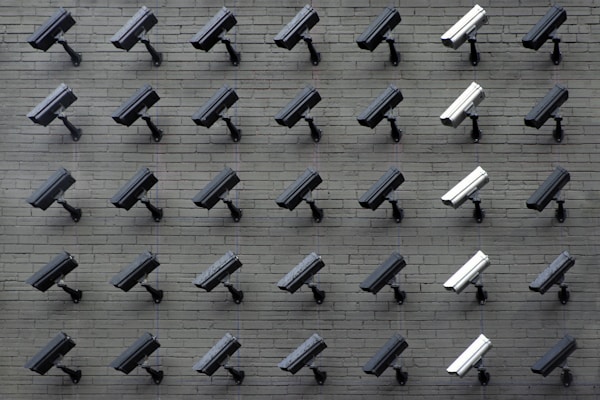
Smart video surveillance overview
Built on the Internet of Things, artificial intelligence, and a cloud platform, this solution gives security manufacturers, integrators, and enterprise and government customers 4G/5G camera connectivity where there is no cable, or where the cameras have to move: construction sites, industrial parks, junctions, coastlines, and scenic areas. Live video, recorded upload, AI for faces, plates, and behavior, and perimeter-intrusion alerts typically use 1–10 GB a month per camera. SimtoLink supplies high-volume IoT SIMs, a shared data pool, and a VPDN private network that meets security MLPS classified-protection and data-security requirements.
Wired security is costly and awkward on a site, a farm, a coast, or a remote stretch. 4G/5G removes that limit: the camera goes in and comes online. The solution covers connectivity, storage, AI, and alerts. Cameras can choose among operators, adapt to a weak signal, and cache video until the link returns. Storage is an SD card plus the cloud, with playback on demand and search by event. AI covers faces, plates, hard hats, high-visibility vests, line crossing, and perimeter intrusion, and edge processing keeps the uplink smaller. Alerts push an intrusion or unusual behavior into the response. It fits smart construction sites, industrial parks, traffic checkpoints, coasts, scenic areas, and bright-kitchen inspections, and it connects to Hikvision, Dahua, and public-security platforms.
Data volume and cost
A camera typically uses about 1–10 GB a month, depending on resolution, frame rate, bitrate, whether the stream is always up, and how much AI runs at the edge. Event-triggered upload plus playback on demand usually holds a camera to 2–5 GB a month. A 24/7 live stream needs 8–15 GB a month. SimtoLink supplies high-volume IoT SIMs, a shared pool across many SIMs, and a VPDN private network that isolates the traffic and meets MLPS classified protection. Multi-operator selection helps coverage in remote areas. Government, enterprise, and public-security deployments should use VPDN so the video stays isolated and compliant.
Which setup fits which site
Smart construction site: Cameras on gates, work faces, and tower cranes. AI looks for hard hats, high-visibility vests, and line crossing. Most video goes up on an event, about 3–6 GB a month per camera.
Traffic checkpoint: Plate recognition and violation detection need a live or near-live upload. Plan on 5–10 GB per camera, or keep a wired link with wireless as backup.
Coast and scenic areas: No cable, so 4G/5G is the link. Solar plus 4G and event-triggered upload typically use 2–4 GB a month per camera.